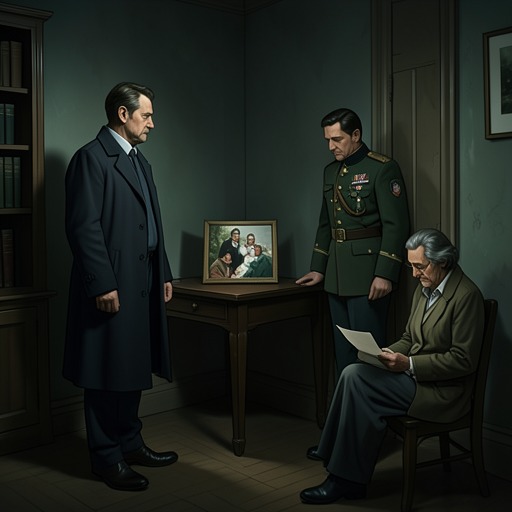
Jacqueline–Colonel Saint-Clair affair and leak
The Day of the JackalJacqueline and Colonel Saint-Clair are lovers, and their relationship becomes an intelligence vulnerability at the heart of the manhunt for the Jackal. Jacqueline passes Valmy confidential details of the police search; when the call is played to senior officials, Saint-Clair identifies her as a friend staying with him and leaves to write his resignation. The affair matters not simply as a private entanglement but because information moving through it repeatedly helps the fugitive evade capture.
Intimacy and Access
The novel presents the relationship through a scene of physical intimacy rather than through an account of its beginnings. Jacqueline lets the straps of her slip fall from her shoulders, draws her lover’s head toward her, and asks him to tell her about what has happened. The scene establishes her closeness to a man who has just been involved in official business; the later revelation identifies that lover as Colonel Saint-Clair. At the time of the recording’s discovery, he confirms that Jacqueline is staying with him. Their private arrangement therefore places her within the domestic orbit of a senior figure connected to the state’s security arrangements.
The text does not establish exactly how Jacqueline obtains each detail she relays, or whether Saint-Clair knowingly gives her information for onward transmission. What it does establish is the conjunction of intimacy, access, and disclosure: she has a private relationship with the colonel, possesses information about the investigation, and communicates it to Valmy. The distinction matters. The evidence exposes the leak and Saint-Clair’s connection to Jacqueline, but does not show him deliberately conspiring with her or specify what he told her in private.
The Leak in the Manhunt
The information she passes concerns a specific, active police measure. Investigators have identified the Jackal’s current disguise as that of a Danish parson and are sorting the registration cards of Danish visitors staying in Paris hotels. Jacqueline tells Valmy that the cards are being checked through the night, with collections at midnight, two, and four o’clock, and that officers will then visit every person on the resulting lists. Her warning gives Valmy a usable account of both the search’s target and its timetable.
The secrecy surrounding the operation makes the call especially damaging. After the Minister of the Interior briefs Lebel, he receives extraordinary authority and builds an office designed to keep the inquiry confidential: Caron is to serve as his sole assistant, and ten outside telephone lines are reserved for the team. Lebel’s initial approach to foreign police is deliberately guarded as well. He says that the authorities have only a tip-off, cannot yet say whether a crime has reached the stage of preparation, and do not even know the suspected assassin’s name. Against this carefully restricted flow of information, Jacqueline’s concise warning supplies Valmy with operational detail unavailable to the public.
The call is recorded and later heard by Lebel and Caron in the DST’s basement communications laboratory. Its spare exchange—Jacqueline identifies herself, Valmy answers, and she reports what the police are doing—turns an unseen channel into audible evidence. The scene makes the leak’s mechanics plain without resolving its full domestic route: information passes from the confidential search to Jacqueline, from her to Valmy, and from the intercepted communication back to the investigators.
Consequences for the Pursuit
Lebel connects the leak to the Jackal’s repeated escapes. Reporting to the Minister, he argues that the fugitive has been kept informed of police progress at every stage. The Jackal left Gap in haste, killed the woman at La Chalonnière and departed before the search closed in; on the latest occasion, Valmy’s arrest and Lebel’s inability to imitate him on the telephone prompted the Jackal to abandon his location and adopt another identity. Lebel also says that on two earlier occasions the fugitive was tipped off after he had briefed the officials gathered for the evening meeting. The disclosure consequently widens the suspected breach from a single intercepted call to a pattern of information reaching the enemy after internal briefings.
Lebel supports his accusation with the portable tape recorder. As the call plays in the conference room, Saint-Clair turns ashen and fumbles with his papers. Asked whose voice it is, he does not name Jacqueline immediately; after Lebel remains silent and the room’s attention settles on him, he says that it belongs to a friend who is staying with him. His response confirms the personal connection while stopping short of an account of how she learned the search details. He then leaves the meeting and returns to the palace to write his resignation. The others remain silent, and the recording has converted a hidden private relationship into an institutional crisis.
Significance and Limits
The affair brings the novel’s competing systems of secrecy into the same room. Lebel’s investigation depends on restricting knowledge, coordinating police resources, and testing what can be safely shared. Jacqueline’s call shows how a private channel can defeat that design: an operation whose details are withheld from foreign colleagues and carefully managed within the police can still reach the fugitive through a personal connection. The failure is not presented as a technical weakness in the recording or the search itself; the recording instead enables the investigators to identify the human route by which the plan was exposed.
Saint-Clair’s position makes the breach consequential even though the evidence does not prove that he personally passed the information. His visible reaction, admission that Jacqueline is staying with him, and departure to resign bind his private life to the investigation’s failure in the eyes of the assembled officials. Jacqueline, meanwhile, is shown acting as the direct speaker to Valmy, but her motive is not explained in these scenes. The relationship’s established significance is therefore specific: it links an intimate domestic setting to the circulation of operational intelligence, helps account for the Jackal’s advance warnings, and ends in the collapse of Saint-Clair’s standing within the security apparatus.